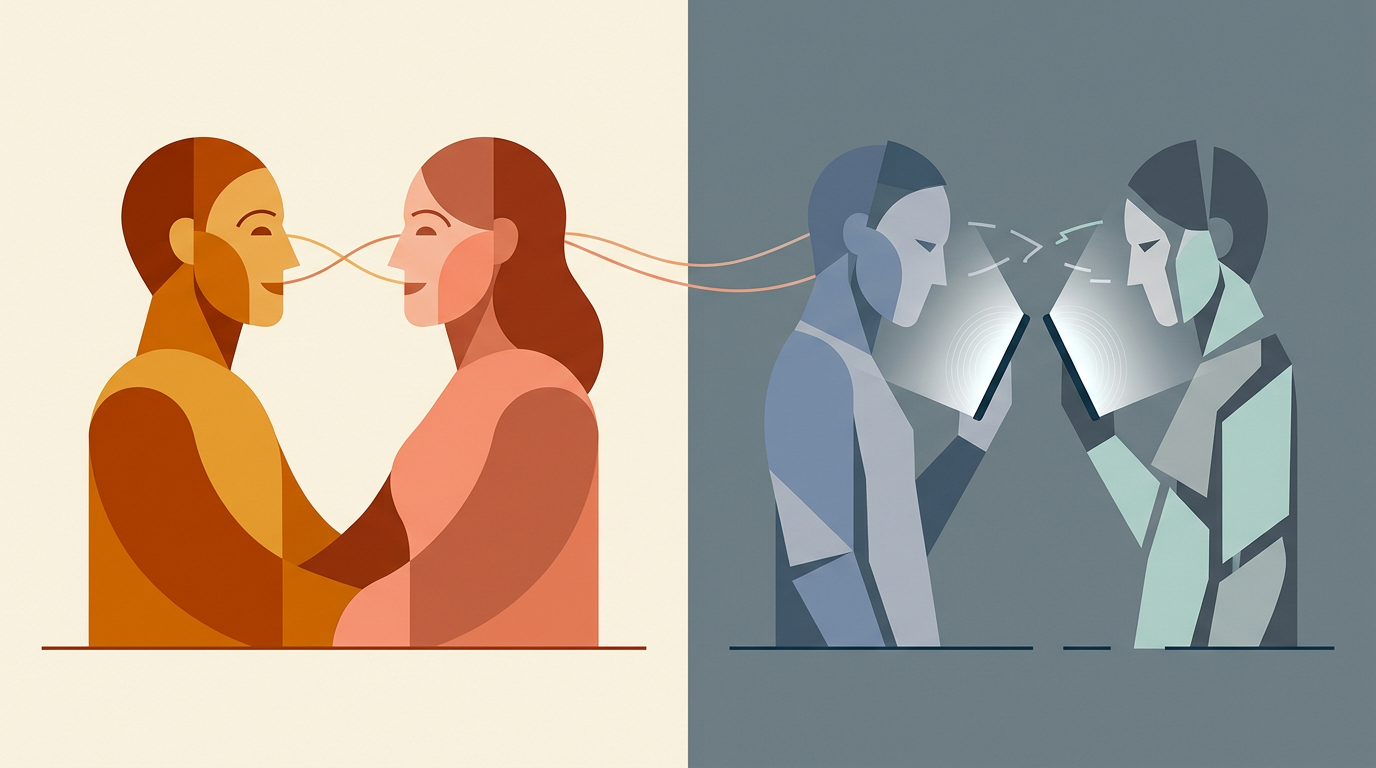
Your phone is right there. He's online. You're wondering what's actually going on in his head — and whether a few well-placed questions might tell you something real.
That impulse makes complete sense. But here's the thing: the medium you're using isn't neutral. Sending relationship questions over text is fundamentally different from asking them face to face, and most advice on the topic treats the two as interchangeable. They're not.
I've spent years looking at how people communicate in relationships — what questions reveal, what responses signal, and where people consistently misread the data they're getting. Text-based communication has its own logic. Once you understand it, you stop over-interpreting the things that don't matter and start noticing the things that do.
Why Testing Love Over Text Is Fundamentally Different
What You Lose When You Remove Tone, Eye Contact, and Body Language
Researchers have long established that a significant portion of emotional communication happens through nonverbal channels — facial expression, vocal tone, physical posture. When you strip all of that out and leave only words on a screen, you're working with a fraction of the signal.
This matters enormously when you're asking emotionally weighted questions. "Do you see a future with us?" hits completely differently when you can see his face soften, watch him pause and actually think, or notice that he reaches for your hand while answering. Over text, you get words. Maybe an emoji. And then you're left filling in the rest — which is where misinterpretation lives.
So be honest with yourself: some of what you're reading into his text responses is you, not him.
What Text Actually Reveals That In-Person Conversations Can Hide
And yet — text isn't just a lesser version of face-to-face conversation. It's a different kind of environment with its own diagnostic value.
In person, social pressure shapes answers in real time. People say what they think you want to hear because they can see your reaction forming. Text removes that immediate feedback loop. He can't see your expression shift when he answers, which means he's less likely to course-correct mid-sentence to manage your feelings. What you get is often more unfiltered.
There's also the written record. Text conversations create a document of how someone shows up over time — their consistency, their effort, their emotional vocabulary. That's data you can actually revisit, which in-person conversations don't give you.
For a broader look at how the medium shapes what questions can reveal, the red flags questions reveal — and how the medium shapes what you hear is worth reading before you start crafting your list.
The Unique Advantage of Text-Based Love Questions
Response Time as a Signal
Response latency — the time between when you send a message and when he replies — is real data. But it's easily misread.
A slow response during work hours means almost nothing. A slow response at 9pm on a Saturday, to a message he's clearly seen, is a different thing. The signal isn't the timing in isolation. It's the pattern. Does he consistently deprioritize messages that require emotional engagement? Does he respond quickly to logistics but go quiet when you ask something that requires vulnerability? That's worth noting.
But (and this matters) — one slow response is not a pattern. Don't build a case on a single data point.
Effort, Length, and Emoji Use as Emotional Data
Here's something I think gets undervalued: the effort visible in a text response is a genuine signal of investment. A three-word answer to a thoughtful question tells you something. So does a paragraph that references something specific you said last week.
Emoji use is trickier. Some people are natural emoji communicators; others find them performative. What you're looking for isn't whether he uses them, but whether his communication style is consistent — and whether he matches your emotional register when the conversation asks for it.
Length alone isn't everything either. A short, specific, warm response can signal more attentiveness than a long rambling one. Look for quality of engagement, not just quantity.
Questions That Work Well Over Text — and Why
Low-Stakes Openers That Reveal Big Things
The questions that work best over text are ones that feel light but create space for real answers. Think of them as low-pressure invitations rather than tests.
- "What's something you've been thinking about lately that you haven't told anyone?"
- "If you could redo one moment from the past year, what would it be?"
- "What's something you want to do together that we haven't done yet?"
These questions don't sound like relationship exams. They invite reflection. And because text removes the social pressure of an in-person exchange, he might actually go somewhere more honest with them than he would face to face.
For a more complete framework of questions organized by intent and depth, see the full question guide for testing love in any context — it covers a lot of ground that text-specific lists tend to skip.
Questions That Invite Reflection Without Pressure
Text is actually a good medium for questions that benefit from thinking time. Questions like:
- "What do you appreciate most about where we are right now?"
- "What's something I do that you don't think I realize matters to you?"
- "When did you first start feeling like this was something real?"
These aren't snap-judgment questions. They reward reflection. And text, unlike a face-to-face conversation, doesn't penalize a longer pause before answering. He can think, draft, revise. The answer you get might be more considered than what he'd say off the cuff.
If you're thinking about how different types of questions serve different relationship goals, serious questions to ask your boyfriend over text (without killing the vibe) covers the balance well.
Questions That Test Consistency Between Text and In-Person Behavior
One of the most underrated uses of text questions is consistency-checking. If he tells you over text that quality time matters most to him, does that show up in how he actually spends his time with you? If he says he's working on his communication, does his texting behavior reflect that at all?
Text creates a record. Use it as one. Not to build a case against him, but to notice whether the person who shows up in messages is the same person who shows up at your door.
Communication consistency across contexts — text, in-person, phone calls — is one of the clearest signals of someone who's genuinely invested versus someone who's performing for the medium they're currently in.
Questions That Backfire Over Text — and What to Ask Instead
Questions That Need Tone to Land Correctly
Some questions are just too tonally fragile for text. Anything that relies on sarcasm, irony, or a specific emotional register to read as safe is going to land wrong on a screen. "So do you actually care about this relationship or what?" might be something you'd say with a half-smile in person. Over text, it reads as an accusation.
Same goes for questions that are emotionally heavy and require immediate visible reassurance: "Do you still love me?" sent at midnight when you're anxious is going to create more confusion than clarity, regardless of how he answers.
| Technique | Best Use | Outcome |
|---|---|---|
| Reflective openers ("What's something you've been thinking about?") | Text, anytime | Creates space for unguarded honesty |
| Future-oriented questions ("What do you want for us next year?") | Text with follow-up in person | Reveals investment without pressure |
| Consistency checks (comparing text claims to in-person behavior) | Ongoing text pattern analysis | Identifies alignment between words and actions |
| Emotionally loaded direct questions ("Do you love me?") | In person only | Requires tone and presence to land safely |
| Sarcastic or ironic questions | Avoid over text entirely | High misinterpretation risk, creates conflict |
| Appreciation questions ("What do I do that you don't mention enough?") | Text | Invites specificity, shows attentiveness |
When Text Conversations Create False Positives
This is the part nobody talks about enough. Text can inflate how emotionally available someone appears.
Some people are genuinely more articulate in writing than they are in person. They craft beautiful, emotionally resonant messages — and then seem closed off or distracted when you're actually together. That gap is important data. If he's a great texter but emotionally unavailable in person, the text responses are a kind of parasocial cue — they create a feeling of closeness that isn't fully grounded in real-world behavior.
Don't let a string of good text conversations substitute for paying attention to how he actually shows up. The questions to ask your boyfriend to test his love — or should you even be testing it? piece gets into this tension honestly.
How to Read Text Responses Without Over-Interpreting
Look, this is where most people go wrong. They get a shorter-than-expected reply and start building narratives. He's pulling away. He's bored. He doesn't care.
Before you interpret anything, ask: is this a pattern, or a moment? A single short response might mean he's driving, tired, or just doesn't know what to say yet. A consistent pattern of short, deflective responses to emotionally meaningful questions is different.
A few principles that help:
Look for effort relative to his baseline. If he normally texts in short bursts and he writes you three paragraphs, that's significant. If he normally writes paragraphs and this time you got two words, that's also significant. Compare to his norm, not an abstract ideal.
Notice what he doesn't respond to. When a question goes unanswered or gets redirected, that's data. Not necessarily bad data — maybe the question felt too heavy for text, which is valid — but it's worth noting.
Don't diagnose from a single conversation. Patterns emerge over time. One weird night of short responses doesn't tell you anything. Three weeks of increasing emotional distance does.
For a deeper look at how questions reveal attachment patterns, 100 serious questions to ask your boyfriend before you go any further is a useful companion resource.
The Bigger Picture: Text Is a Supplement, Not a Test Environment
Here's the honest conclusion after all of this: text is genuinely useful for relationship insight, but it's a flawed testing environment if you treat it as the primary one.
The questions that reveal the most about a relationship are still best asked in person — where tone, presence, and nonverbal response all contribute to the full picture. Text can supplement that understanding. It can reveal consistency, effort, and emotional vocabulary. It can give him space to reflect on things he might deflect in real time. But it can't replace the full signal of being in the same room.
So use text questions strategically. Pay attention to patterns, not individual moments. And when something in his responses raises a question for you, bring it into a real conversation rather than trying to resolve it through more texts.
The medium shapes what you hear. That's not a reason to avoid text — it's a reason to use it with your eyes open.
Start by picking one reflective question that genuinely interests you — not one designed to catch him out — and send it. Watch not just what he says, but how he engages. That's your real data.